
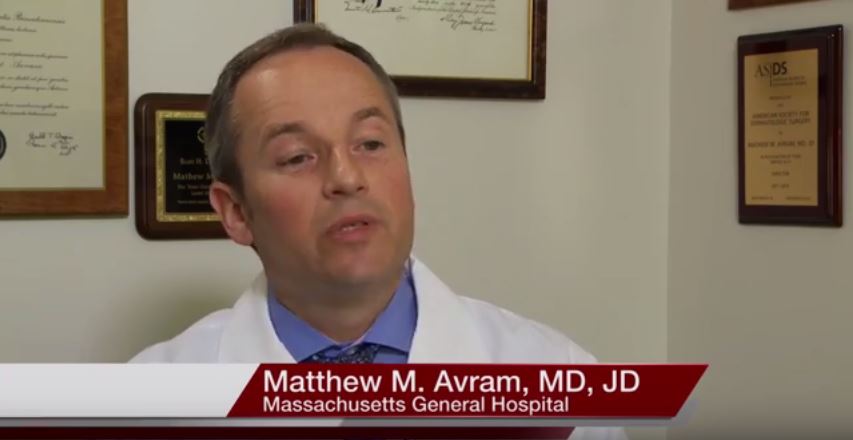
Mathew Avram, M.D., JD, Director of Massachusetts General Hospital’s Dermatology Laser & Cosmetic Center in Boston talks about two new FDA-approved treatments that are helping people turn back time.
Interview conducted by Ivanhoe Broadcast News in August 2016.
We are talking about two different types of lasers. Tell me about BBL, what is that all about?
Dr. Avram: Well, BBL stands for broad band light; essentially a broad band light is a very powerful flash lamp. It is just a regular light and theRE are cut off filters in this technology that are specifically designed to treat brown PIGMENT and redness. By treating the browns and the reds it also helps with texture and tone as well.
How exactly does it work?
Dr. Avram: What happens is the pigment in your skin absorbs the light and by absorbing it with that energy, it breaks apart the pigment cells and over a period of about a week the pigment clears out. Similarly, it treats the redness by targeting blood vessels. The blood vessels absorb the energy and over a period of a few weeks they are removed by the result of absorbing that energy and being cleared.
What can the patient expect with the BBL aftermath?
Dr. Avram: The BBL treatment is actually very comfortable. It is not something that you even need anesthesia for. Typically, what patients experience is a little bit of redness and their brown spots get a little bit darker and that last maybe for a few days or up to a week. It is not something where you have pain afterwards or there is any wound care and you just kind of go back to your regular lifestyle.
What have you seen for outcomes in someone that has had BBL done?
Dr. Avram: The BBL the outcomes are very consistent and we see a nice improvement. The things that it really works for is again, is pigment; people with freckles; sun spots or just discoloration of their skin; as well as, redness. Things like rosacea, broken blood vessels and all the things that are really caused by sun damage. What we see as a part of that also is the texture and tone of the skin getting a little bit better. Patients look better in terms of the discoloration; they have the redness, as well as, the texture and tone. They just look refreshed and look cleaner. It is a nice treatment to do after they have been maybe in the sun a little too much over the summer.
How is it different than other lasers that are out there?
Dr. Avram: One distinction about the broad band light is that it is not a laser. Laser technically means that there is one wave length of light. Broad Band Light is a flash lamp and THAT HAS many different waveLENGTHS of light that are cut off in different areas to particularly focus on issues such as redness, discoloration and brown color. The nice thing about the Broad Band Light is that you can treat more than one thing at once. You can treat red and brown. The lasers traditionally will treat brown very well or red very well, but not the both at the same time.
With BBL is pain really involved?
Dr. Avram: The BBL has a mild amount of pain. We do not need any topical anesthesia, it is not a procedure, you know, WHERE patients get white knuckleD during it, which tends to be a very comfortable procedure.
Is there anything I have not asked you about BBL that I should have?
Dr. Avram: The time of treatment is really just about five minutes to treat an entire face. It is something that someone can get done in a fifteen minute appointment easily and go back to their other activities. If they have a lot of brown discoloration and that darkens they may want to put a little makeup on for a few days afterwards, but the nice thing about it is, there is not much recovery period. You can do it very quickly and get back to your other activities.
Tell me about Halo?
Dr. Avram: Halo is a laser device that uses two lasers at once to help with pigment, to help with pore size, texture and tone of the skin; it can also help with wrinkles and acne scars. What is amazing about the halo is it only treats a small portion of the skin when you are doing the treatment, but it affects the entire skin and gives benefit to it. So, what the laser does is it will only treat twenty, twenty five percent of the skin but it will have effects for the entire skin itself. The way it does that is, it focuses on the laser into the skin. The deeper into the skin to get to the areas where we have more sun damage, or scars, or lines and it has areas in between each one of those laser pulses that are not affected what so ever. By creating a little area where you have the laser firing, you have surrounding tissue that has not been affected that can heal very quickly. The way the waves are fired through two different lasers, one of them just brings in a little bit of heating into the skin, the other one actually takes away a little bit of the tissue and it does it simultaneously. What is wonderful about this device is it is not very painful. We do give topical anesthesia for the procedure, but you think that if you had two lasers at once, you would be in more painful, but for some reason it is actually less painful than the other devices that try to do the same thing. What the halo does is it provides help with texture, tone, pigment, pore size, lines, and acne scars by using two lasers at once. They only treat a portion of the skin but provide benefit for the entire skin while not providing a lot of pain and also not having a lot of down time. The down time is just a few days.
What would a person expect for down time? Is there scabbing?
Dr. Avram: Down time is typically a little bit of redness and swelling. There might be a little bit of peeling of the skin and that lasts for about three to six days on average.
Do people put ice on their face?
Dr. Avram: Afterwards, we advise people to ice; just to help with swelling and then we just have them put on a topical moisturizer on their skin or sunscreen because it helps the healing process go a little bit more quickly.
With both of these procedures how long does the effect last?
Dr. Avram: The effects can last for years what is the most important thing is if you get the treatment and you stay out of the sun you are going to see the benefits last much longer. If you get these treatments and you go right back in the sun you are going to see that pigment come back a little bit sooner and the texture and tone may not last quite as long. Having said that with a standard treatment, the improvement in pigment, texture, tone, redness, fine lines and pores should last for a few years.
Is that with both BBL and halo?
Dr. Avram: Yes.
So you could even stretch it if you are really good with your skin?
Dr. Avram: Yes, what I advise all my patients is that sunscreen and sun avoidance are things that are going to increase the longevity of your treatment. If you are careful in the sun and you behave the way you should, after the treatment they will last that much longer, but this is not something that you do every few months and then repeat over and over. This is a treatment that will provide benefits for years.
For halo, if you want to keep it up, would you do it once a year?
Dr. Avram: I personally use the halo treatment myself and I do it one time a year and that is both to improve the wrinkles that I have gotten over time, but also to prevent new ones from coming on. I feel like doing it once annually is a nice way to improve my skin and to prevent further sun damage from coming sooner than I want it to appear.
What about with BBL?
Dr. Avram: BBL as your pigment comes out; as you have more discoloration of your skin you would do the treatment. The time period that it is going to last is going to depend upon how often you go back in the sun; that can last for years if you stay out of the sun. It could last longer than that if you get a treatment and you go right back out in the sun you may find yourself feeling that you need the treatment sooner than that, however.
Was there sort of a maintenance package with the BBL like halo you would do once a year? With BBL would you try and keep that up?
Dr, Avram: It really varies from patient to patient, I like having a maintenance package for patients from the standpoint that if they feel, basically let the patients tell me when they feel like they want to see an improvement in their skin. That is when we do the treatments again. Having said that, doing it in a preventative fashion I think is a nice way to stay ahead of the curve so that you do not need to do something more drastic down the line.
Can you stack the treatments, or are they supposed to be done completely separately?
Dr. Avram: You can do the BBL and halo one at the same visit and that is something that we are going to be doing today with our patient Laurie. We are going to do the BBL and then switch right over to the halo all at once. You can do several treatments on a patient if they need a little bit more help and when we do the halo treatment we may do it once or twice to get a little more benefit for a patient. We usually space those about a month apart.
When you said you only do a portion of the skin do you mean the depth or around the face?
Dr. Avram: That’s a very good question. No, it’s a good question because I have to make that clear. Basically what is happening is this is your face, the lasers are putting little pulses on it but should I put like a smiley face or anything? What is happening is it is putting little dots randomly, but in between there are spaces that are not being treated at all. You are putting in these columns, you are putting these on what we call is zones of thermal damage but you do not want to say it, but basically you are putting columns of light into the skin. Around the columns is skin that was not treated by the laser at all, but the skin surrounding those columns is coming in and healing the skin around it like an immune response.
Is there anything that I did not ask you?
Dr. Avram: One of the take home points is that you are only treating a portion of the skin, but you are really rejuvenating all the skin. It is not very painful without much down time and those are the key points.
END OF INTERVIEW
This information is intended for additional research purposes only. It is not to be used as a prescription or advice from Ivanhoe Broadcast News, Inc. or any medical professional interviewed. Ivanhoe Broadcast News, Inc. assumes no responsibility for the depth or accuracy of physician statements. Procedures or medicines apply to different people and medical factors; always consult your physician on medical matters.
If you would like more information, please contact:
Carolyn Catinazzo Peggy Chung
Ccatinazzo@partners.org 650-493-9155
www.sciton.com
Sign up for a free weekly e-mail on Medical Breakthroughs called First to Know by clicking here.